Posts

Showing posts with the label Things to see in Bihar

Remains of Ancient Vaishali and Ashoka Pillar , Kolhua ,Vaishali, Bihar , India

Image
  Remains of Ancient Vaishali , Kolhua :-             Stupa & Pillar :- Kolhua, a part and parcel of ancient city of Vaishali marks the spot where a local chief of monkeys had offered a bowl of honey to Lord Buddha. The event is regarded as one of the eight most signigicant events of his life. According to the Buddhist literature, this was the place where Buddha spent many of the rainy seasons, Allowed Nuns to the Sangha for the first time , announced his approaching Nirvana and converted Amarpali from a proud court dancer to a nun.         The recent excavation conducted by Archaeological Survey of India have revealed remains of Kutagarshala , Swastika shaped monastery , a tank, number of votive stupas and miniature shrines in addition to main Stupa and the Ashokan Pillar which were exposed earlier. The pillar locally known as Lat is 11.00 meters high monolithic polished sand stone column surmount...

Mahatama Gandhi Setu , Patna

Image
Mahatama Gandhi Setu , Patna Mahatma Gandhi Setu  (bridge) also called Gandhi Setu or Ganga Setu in Patna is the Asia's 2nd longest river bridge and also longest cantilever bridge of Asia.  Length of Ganga Setu in Patna is 5.75km and was inaugurated in 1982 by Indira Gandhi with the cost Rs 87.22 crore. It is also one of the tourist’s spots in Patna, Bihar. Mahatma Gandhi Setu connects Patna in the south to Hajipur in the north of Bihar. The bridge was approved by the Central Government in 1969 and built by Gammon India Limited over a period of ten years, from 1972 to 1982 with total expenditure of Rs 87.22 crore at that time.  It was built to connect North Bihar with the rest of Bihar and part of national highway 19 (NH19). . Before this bridge was constructed, Rajendra Setu, opened in 1959, was the only link to North Bihar. The Indian postal department issued a commemorative postage stamp on Landmark Bridges of India: Mahatma Gandhi Setu of denominatio...

Morton Toffee Factory, Marhowrah , Bihar

Image
Morton Toffee Factory, Marhowrah , Bihar The history of Marhowrah dates back to Vedic period as the two famous temples situated here have references in sacred Hindu scriptures. In modern period, it was part of British colonization, as old British established factories and buildings are still famous landmarks in the town. Once a vibrant place humming with a tinge of colonial culture and factory life, Marhowrah in Saran district has slowly turned into a graveyard of industries. The town has a rich industrial history, Marhowrah boasted of four factories of national fame — Kanpur Sugar Works, Morton Confectionary, Saran Distillery and Saran Engineering Works. As all four of them closed down one by one more than a decade ago. C & E Morton was a large packaged food producer. C &  E  Morton (India) Limited carried on the business of manufacturing various kinds of confectionery in their factory at Marhowrah in Bihar and sells its products under the trade name "Morton...

Agam Kuan , Ashoka’s Hell

Image
Agam Kuan , Ashoka’s Hell    Agam Kuan  which means ”unfanthomable well” is an ancient well and an archaeological site situated in Patna,Bihar,India. The Agam Kuan is set within an archaeological site identified by the Archaeological Survey of India which also contains the adjacent Shitala Devi temple where the folk deity Shitala Devi is venerated. It is said to date back to the period of Mauryan emperor, Ashoka (304–232 BCE). The well was known to be part of “Ashoka’s Hell “. It’s a legend that Ashoka threw 99 of his brothers in this well after killing them for the throne of Magadh. The well is believed to be 105 feet deep, Circular in shape, the well is lined with brick in the upper 13 metres (43 ft) and contains wooden rings in the remaining 19 metres (62 ft). The surface structure, which now covers the well and forms its most distinctive feature, has eight arched windows. A hand written plate stuck in the wall of the well reads "The well of Emperor Asoka"...

Ancient Panch Mandir,Chapra

Image
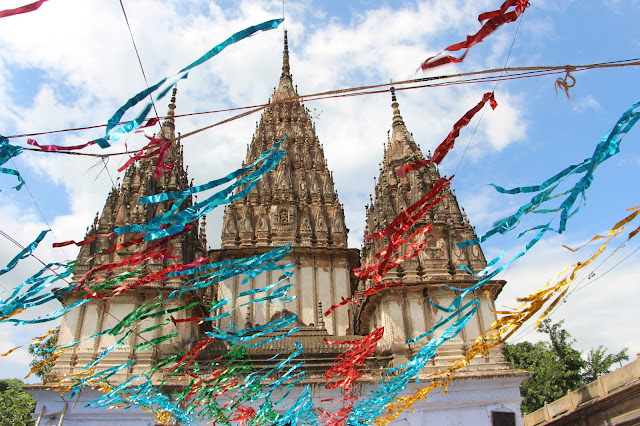
Ancient Panch Mandir, Chapra The ancient Panch Mandir is a beautiful temple built by Kayasthas ,mentioned in autobiography of Dr Rajendra Prashad , 1 st   president of India . It is situated in Bhagwan Bazar location of Chapra town in Bihar.  Architecturally two-three hundred years old... Having Curvilinear    shikhar, urushring ,Nagara style of temple architecture. Not much information available. Local residents in the complex are not very friendly to visitors. 

Buddha Stupa ( Kesariya Stupa ) ,Kesariya , Bihar

Image
Kesariya Stupa ( Buddha Stupa ), Bihar : Situated in the East Champaran district of Bihar, Kesariya serves as the place of the largest Buddhist stupa in the world. Kesariya stupa, as it is known, is located at a distance of about 110 km from Patna, the capital of Bihar. The stupa is believed to date back to somewhere between 200 AD and 750 AD may have been associated with the 4th century ruler, Raja Chakravarti. The local people call this Stupa as Devala, "means the house of god". Before the excavation of this, they believed that inside it there is a temple of 'Lord shiva' which is built by king Bhema .  The stupa is the largest in the world, with a height of 104 ft, and attracts lots of Buddhist pilgrims from around the world. The stupa is rare example of Buddhist architecture and archaeological preservation. It is believed that the stupa has further immersed into earth after the famous 1934- earthquake before which, the height of this stupa was 123 ft....

Maner Sharif , Patna

Image
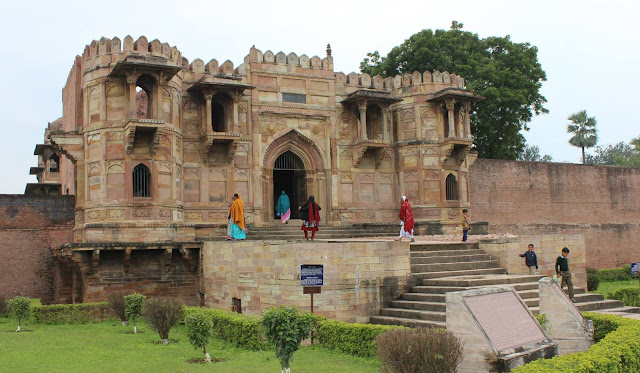
Maner Sharif , Patna, Bihar : Maner is a town situated 25 Km from Patna on bank of Ganga. Maner was the western gate of Patliputra (Patna) in the Mauryan rule. It is believed the town is named after the Sufi saint Hazrat Makhdoom Yahiya Maner , whose tomb is known as Bari Dargah . The Tomb of Makhdum Shah Daulat, locally called as Chhoti Dargah , is situated in Maner. This mausoleum is the finest Mugal monument in Bihar and is remarkable for its architectural elegance and rich decorative carvings. It was built in 1616 A.D. by Ibrahim Khan Fath Jang, Governor of Bihar under the Emperor Jahangir, over the grave of his religious preacher Makhdum Shah Daulat who according to the Persian inscription over the southern enterence, died in 1608 A.D. . The mosque to the west was completed in 1619 A.D. and the gateway on the north in 1623 A.D. Architecturally it is the finest specimen of its time in Bihar. In the centre it houses the grave of Saint Makhdum Shah Daulat and of Ibrah...